|
|
|
 |
This
article is reproduced from the Divernet.co.uk website and is written by
John Liddiard
If
you have regular access to a swimming pool for dive training, don't
waste any valuable underwater time, suggests -
use it to hone your skills in preparation for the next training course
AS AN INSTRUCTOR,
I am often frustrated by divers who are not really prepared for the
training they are about to undertake. It's not just me. Those who are
unprepared also hold back the others on the course, forcing me to
dedicate a disproportionate amount of my time to the unprepared and
giving less to those who have made the effort.
The
skills any diver
is expected to bring along to a course naturally vary with the level of
the training. For any given course, there are skills that a diver is
expected to have already mastered, and skills that a diver would quite
rightly expect to polish or learn from scratch on the course.
After
all, if there were nothing new to learn, there would be little point in
doing it.
On
the theory part of any training, the answer is easy - read the manual
from cover to cover before the classroom work begins, and perhaps even
do some of the example exercises. That way, by the time the real
training starts, a diver will know which bits present difficulties, and
the instructor will be able to concentrate on those parts.
That's
preferable to having to talk through information that could just as
easily be read from the manual.
On
the practical side, the most commonly sub-standard skill is buoyancy
control. Even divers who think they have good control are often
negatively buoyant and finning to stay level. Provide the distraction
of an exercise, and they soon sink.
It
shows up readily on
out-of-air drills. In basic training, OOA is practised on a flat
seabed. The divers swim towards each other and kneel on the seabed to
sort out octopuses and prepare for the ascent.
That's
OK in basic
training, but many real dives are on a wall. Many real OOA incidents
happen when an ascent has already started. In both cases, the last
thing we want to happen is to begin the emergency drill by sinking and
making the incident worse.
I
like to make drills on advanced and technical training more realistic.
Having
introduced an exercise on a flat seabed or a training platform, drills
move on to a wall or midwater, with just a shotline for reference. This
applies not only to OOA, but all drills.
Phrases
that come up all
the time in technical training are "task loading" and "perceptual
narrowing". While a diver may be able to focus on one task, perhaps
even two, start adding more and soon the diver becomes overloaded.
One
or more of the tasks becomes neglected as the diver's brain looks for a
way out, and perception focuses on something that can be achieved,
often at the expense of failing to cope with more important issues.
It's
what happens when practising the OOA drill on a wall. The divers are so
busy worrying about the drill that barely adequate buoyancy becomes
neglected and they sink.
The
trick about mastering buoyancy control is to practise it in the pool in
association with other drills.
What
these drills are depends on the level of training. The important thing
is to develop a feel for keeping neutrally buoyant while distracted.
Out
of air and alternative air source is an obvious starting point. With a
view to moving on to technical training, gas shutdown and
stage-cylinder removal and refit are skills that benefit from some
concentrated practice before a formal course begins.
All
of these
can be safely practised in a swimming pool, even for the first time,
without an instructor. Just have a capable friend watching to help out
if things get out of hand.
Out Of Air and Alternative Air Source
are skills worth practising at all levels, from beginner to technical.
In
its simplest form, begin the exercise separated by several metres,
neutrally buoyant and hovering horizontal in the water, halfway between
the surface and the bottom of the pool. In a typical 3m-deep pool, this
will give 1.5m above and 1.5m below. Take enough time to ensure that
genuine neutral buoyancy has been achieved before starting the actual
OOA exercise.
I won't go into the details here, except to say that
there are variations based on training agency, equipment configuration
and the level of training.
What is more important at this stage is
to make contact and donate/receive the AAS while keeping horizontal and
without sinking to the bottom of the pool or breaking the surface.
While
the objective of the exercise is obviously for both divers to end up on
the surface and positively buoyant, we want this to be intentional
rather than a result of losing control of buoyancy!
Initially, just
practise with pool kit or wetsuits. As control improves, move on to
doing it with gloves and in full kit with drysuits.
In the middle
of this, work at increasing the separation between divers and doing it
all without masks. Not because this will ever happen in real life, but
because doing anything without
a mask will add to the task-loading and make divers develop a feel for
buoyancy, rather than relying on visual references.
As
soon as divers move on to a manifolded twin-set, gas shutdown is an
essential survival skill. If you are diving with a manifolded twin-set
and have not mastered this skill, the only safe option is to keep the
manifold closed and dive as if the set were independent cylinders.
Shut-down
drill is a key skill taught and practised on any entry-level technical
course on which a twin-set is used, but that doesn't mean you can't get
a headstart with a bit of practice in the pool. Most divers with
twin-sets end up taking them diving before they take them on a
technical course, so they may as well practise shut-down
drills.
The
sequence for shutting down varies between agencies, so that is a detail
to leave to the official training course, or check with your
instructor.
More important at this stage is simply to get used to reaching and
operating the isolator tap and the individual cylinder taps.
Begin
by resting on the bottom with just a light wetsuit and the twin-set,
and reaching back to locate and operate the taps. The positioning of
the twin-set on the backplate may have to be adjusted slightly to find
the most comfortable location.
With the basic movement well
rehearsed, the skill can be developed in the pool by continuing to
practise while neutrally buoyant in midwater, with gloves on, in a
drysuit, and even without a mask. It is worth moving on to the
neutral-buoyancy part early in the development of the exercise.
The order in which the other components are developed is unimportant;
whatever takes your fancy.
As
with the OOA exercise, the mask- off bit is not something you would
ever need to do for real. It is just a way of injecting a bit more
stress.
If you're just thinking of buying a twin-set, rig up a set of
independent twins and practise shutting them down one at a time.
In
most training schemes, removing and refitting a side-mount cylinder is
a skill that comes in later than using a twin-set, but that is not
necessarily the case. Some single-cylinder open-water divers prefer to
carry a bail-out pony cylinder side-mounted rather than on their backs.
For some, removing and refitting a side-mount is an easy skill. For
others it is more difficult.
The positioning of D-rings can be a compromise between comfort while
diving and ease of removal and refit.
The
awkward D-ring is often the hip or back one to which the lower clip on
the side-mount attaches. It can be quite a challenge to fiddle a
bolt-snap onto it while wearing gloves.
There are a few tricks on
kit-rigging that can make this easier. For example, D-rings welded to a
backing plate or backed with a plastic clip will stand out, rather than
fold where they are difficult to find.
As with gas shutdown, get
the basics sorted out by resting on the bottom of the pool while
removing and refitting the side-mount. The exercise can be done top
clip or lower clip first, and while you may find one method easier than
the other, it is worth practising both because you never know when
circumstances will conspire to force you to use the other method.
With
the basic movement sorted out, the next step should be to get the feel
for it with gloves on, then move into midwater before adding full kit
and a drysuit (still in the pool, of course).
For a final
challenge, see if you can do it all without a mask, just to complicate
matters and add to the task-loading while trying to maintain neutral
buoyancy.
While you have the side-mount in the pool, another trick
to play with is "trailoring" a side-mount by attaching its top clip to
the hip D-ring. This is a convenient way to get an empty and floaty
aluminium cylinder out of the way when it has been finished with on a
decompression stop.
It isn't particularly useful with just one side-mount, but can come in
handy when more than one is carried on the same side.
If
you are warming up for a more involved technical course using more than
one side-mount, the pool is the place to get in some advance practice
for that as well.
While
you have all your dive kit in the pool, another skill that may come in
useful one day is to take your harness/ BC/wing/cylinders off your back
and put it on again.
You are most likely to need this skill on
real dives at the surface when diving from a small boat and needing to
dekit in the water, or from a really small boat, where there is not
enough room to kit up onboard and you have to throw the kit in and put
it on in the water.
Removing full kit while under water is a skill
that may be taught on advanced wreck penetration or cave courses. It is
not something to make a habit of during normal diving, but is still
worth practising. One day, when circumstances conspire to make it
necessary, you will at least have an idea of what to do - but only as a
last resort. In most cases the safe option is to return to the surface
to sort out a problem.
|
 |
 |
 |
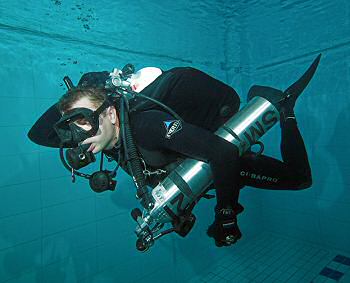
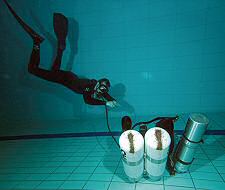
| Practising a gas
shutdown |
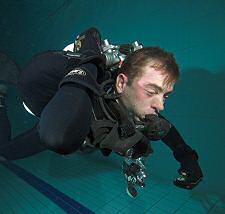
doing
any exercise with mask off serves to add to the stress levels |
reaching back to
operate the mainfold valves |
 |
 |
|
| Practising
side-mount removal and refit |
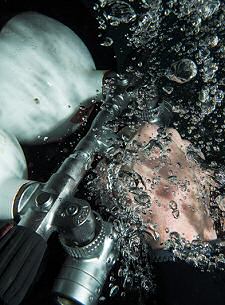
You
never know when the ability to remove all your kit and put it back on
will come in useful. |
|
|
|
|
|
| |
| |
| |
| |
| |
| |
| |
| |
| |
| |
| |
| |
| |
| |
|
|
 |
|
|
|
|
| |
|
|
|
|
|