|
|
|
 |
|
Dive Kit
-
Are You Overweight - Diver, Anne-Marie Kitchen-Wheeler
Did
you know that, for every unnecessary kilogram of weight you add to your
belt you can use up 10% of your gas supply in compensation? Anne-Marie
Kitchen-Wheeler wants us all to become weight-watchers.
-
Diving with Wings - Dive, Charlotte Boan
When to make the switch from a stab jackets to a wing.
-
The Truth About Drysuits - Diver, Mike Ward
There's what they tell you in those fancy catalogues, and then there's what divers learn through bitter experience.
-
What a Drag! - Dive, Charlotte Boan
Configure your kit to reduce drag.
Diving Skills
-
50 Ways to be a Better Diver - Dive, Charlotte Boan
From buoyancy to buddies, kit configuration to boat etiquette 50 tips on how to do it better!
-
The Art of Drinking and Diving - Diver, Mark Brill & Laura Harris
Diving while your body is dehydrated leads to aching muscles, fatigue and even decompression sickness - it's that serious.
-
Buoyancy for Beginners - Diver, John Bantin
Good
buoyancy control is the essence of pleasurable diving. Making yourself
perfectly neutral so that you neither float up nor sink renders your
diving effortless. So it's a pity that so many divers never seem to
master this basic technique, says John Bantin
-
Buoyancy Masterclass - Dive, Charlotte Boan
Good buoyancy skills separate the real divers from the wannabes. But how do you perfect buoyancy?
-
Coping with Nitrogen Narcosis - Dive, Dr Pete Larkin
Euphoria or desperation? it Affects us all in
different ways. Dr Pete Larkin finds out the truth about getting
‘narked’
-
Current Affairs - Diver, John Bantin
John Bantin offers his rough guide to tides and currents.
-
Doing It Wrong - Diver, John Bantin
John Bantin shares 20 of his ripest bloopers, from each of which he gleaned another valuable nugget of experience.
-
Edge of Darkness - Dive, Charlotte Boan
Diving in low visibility
-
How to Dive in Current - Dive, Charlotte Boan
A panel of diving experts give tips and advice on how to get the best out of currents and tidal movements.
-
How to Deploy a Delayed SMB - Dive, Charlotte Boan
Incidents attributed to poor SMB deployment incresed in 2005; here's a
step-by-step guide to deploying an SMB from a wreck and from mid-water
-
Setting the Stage - Dive, Charlotte Boan
A
panel of diving experts - Jeff Reed, Clare Peddie and Richard Bull -
give their tips and advice on decompression diving.
-
Take a Deep Breath - Dive, Andrew Spooner
How free-diving techniques can enhance your scuba diving skills.
-
The Subtle Art of Stopping - Diver, John Bantin
Some
divers do, some don't. Make decompression stops, that is. Those who
don't may be over-cautious, those who do may become complacent.
-
Year of the Lotus - Diver, Jacqui Cozens
Jacqui Cozens considers an approach to diver fitness and improved breath-control that taps into traditional Eastern wisdom.
Plan Wisely Dive Safely!
|
|
Kit Configuration
When you go diving, are you free to concentrate on the dive and enjoy
the experience? Does all your equipment fall to hand when you need it?
Can you operate all your kit without a second thought, smoothly and efficiently?
Or...do you spend half the dive adjusting your buoyancy, clearing your
mask, bashing your torch to make it work or re-clipping that dangling
hose? Is the whole dive more of a kit battle than a serene meander through
a majestic underwater landscape? Worse still, do you enter the water already
exhausted from the struggle to get into all that kit? If so, then perhaps
you should take a long hard look at your kit and it's configuration to
see what you can do to make life easier for yourself. After all, we dive
for fun not as a precursor to entering Gladiators!
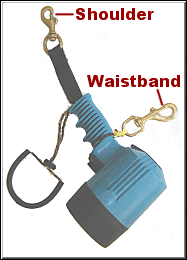 As
an example, take a used an Ikelite RCD50 pistol style torch. Whenever a memeber of the club did
a stride entry,they were concerned that it would swing up and bash them. The
problem is that this torch has only one place to attach a lanyard/clip
so it always swings around from its d-ring.They put up with this for years
before finally deciding "enough is enough". Sitting down with
my harness and the torch, they thought, "what would be the ideal attachment".
It soon became apparent that all theyI needed was an extra clip somewhere.
The lanyard would clip to the chest d-ring and another clip to the waistband
d-ring. As
an example, take a used an Ikelite RCD50 pistol style torch. Whenever a memeber of the club did
a stride entry,they were concerned that it would swing up and bash them. The
problem is that this torch has only one place to attach a lanyard/clip
so it always swings around from its d-ring.They put up with this for years
before finally deciding "enough is enough". Sitting down with
my harness and the torch, they thought, "what would be the ideal attachment".
It soon became apparent that all theyI needed was an extra clip somewhere.
The lanyard would clip to the chest d-ring and another clip to the waistband
d-ring.
So, they added an extra snap bolt which is tied to a cable-tie around the
top of the handle as you can see on the left. This clips to their waistband
whilst the original lanyard clips to the shoulder. As a side effect, if
the torch is turned on accidentally, they can see the beam in the water due
to the way it hangs.
So, what's the moral of this? It's that you don't need to put up with
less than ideal kit configurations especially if they are spoiling your
dives. Sit down with your kit at home and think about which bits of it
cause you problems in the water. Here's another example and it's a classic.
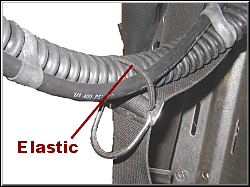 Do
you find that your BC inflator hose disappears up over your left shoulder
during the dive making it difficult to find when you need to adjust your
buoyancy or start your ascent? Normally, this is annoying but it could
prove dangerous. If you can't dump air you could end up with an uncontrolled
ascent. Here's whatyou can do about it.... Do
you find that your BC inflator hose disappears up over your left shoulder
during the dive making it difficult to find when you need to adjust your
buoyancy or start your ascent? Normally, this is annoying but it could
prove dangerous. If you can't dump air you could end up with an uncontrolled
ascent. Here's whatyou can do about it....
A piece of bungee elastic is fixed to the shoulder strap and the direct
feed corrugated hose is passed through it. This maintains the inflator
in a position where youI can always reach it but at the same time allows
it to be raised above the head for dumping. If you look carefully at the
picture, you'll also notice in the picture that the direct feed hose is connected to
the corrugated hose using a couple of pieces of bicycle inner tube. Keeps
it tidy and reduces the risk of its snagging on a bit of wreckage.
So, why not take a look at your kit, think about your diving and see if there
isn't something simple you can do to make your diving easier and more enjoyable?
Of course, you need to be careful modifying your kit, you don't want to compromise
its purpose or make the situation worse. If you're not sure about anything,
please ask someone in the club. The seniorclub memeberswill be happy to discuss kit configuration issues or put you on to someone
who is better able to help.
As a final note something you may like to consider...The dive knife
- where is yours when you're diving? Could you reach it easily if you
get entangled in some fishing line? Have you ever tried? If you can reach
it in a stressful entanglement situation, what happens if you do manage
to get it out only to drop it? And, if it is within reach and secured
to your kit with a line, will it cut monofilament line? When was the last
time you tried it? If you carry scissors or sea-snips, when did you last
check that the hinge hadn't corroded away - it's happened!
|
|
The DSMB
Hopefully everyone in the club has seen a Delayed Surface Marker Buoy
(DSMB). If not, you should ask another member to show you theirs(!). The
DSMB is used to indicate your position in the water to your surface cover.
This allows them to a) follow you as you drift or swim along and b) not
run you over when you surface. I'm sure we all realise the advantages
in this! When you've done a bit of diving you'll realise that it also
means that the boat is on hand when you surface meaning you don't have
to bob around in the water for ages waiting to be picked up - definitely
a plus point in my book!
(I should know more than anyone - Fishguard experience!)
This piece of kit is known as "delayed" because you only deploy
it (send it up) towards the end of the dive. It is inflated using air
from your cylinder (usually from your octopus). Sounds like a good idea
so what's the big deal? you ask.
Normally one person in a buddy pair needs to carry a DSMB. Even if you
plan to come back up the shot line, one of you should have a DSMB. Why?
Well, in case you can't find your way back to the shot, you can send it
up to indicate your position. Sometimes, you get back on to the shot and
find that there is quite a current running. In this case, it might be
more comfortable to send up the DSMB and then "let go" of the
shot line to drift free in the current. In this case the boat needs to
know where you are. Often, the skipper will ask you to come up on a "delayed".
This might be because he wants to recover his valuable shot line once
everyone is safely down or beacuse he knows there will be a current running
at the end of the dive and he cares about your comfort. In this case,
all divers should do the same otherwise some end up drifting with
the current and others remain static on the shot - a boat handler's nightmare!
Your webmaster's pet rant right now is that all divers should
carry their own DSMB and know how to use it. One per buddy pair
is not enough! This means buying more kit and learning how to use it in
the pool - but that's not a bad thing eh? It could prove invaluable on
your dive or even save your life! I've been in the situation where being
able to wave a long orange object above the swell has been the only way
to attract the attention of the dive boat...!
Plus, consider this. Your dive turns into a swim through sludge - the
vis is less than perfect and, through no fault of your own, you loose
sight of your buddy. What do you do? Well, as per your training,
you spend a short amount of time looking round for your buddy before surfacing
alone. In this case, suppose your buddy was carrying the DSMB! How do
you surface safely without being run over by a RIB and without drifting
off and not being spotted? You guessed it! You deploy your own spanking
new DSMB which you purchased for exactly this eventuality!
You may think this is overkill and that you will not become separated
from your buddy. Rest assured, one day it will happen and it's best to
be prepared for this. If you're currently training, your instructor will
not let you out of his sight so it's not too much of a problem at this
stage (this is one of the reasons why your instructor may cancel a dive
- if he/she thinks there is a risk you could become separated). However,
once you are qualified you need to think much more about taking responsibility
for your safety. As ever, speak to a more experienced member of the club
if you are in any doubt whatsoever.
Oh! And bear in mind that, if you do need to deploy your DSMB as a "reserve"
you could be mid-water. So practise deploying when you're not conveniently
kneeling in the sea bed.
There are various types of DSMB - again, ask others to see what they
like and use. Most of them are orange or red sausages which are open at
the bottom to receive air. Some have a self-sealing mechanism which stops
them deflating on the surface. Still others come with their own small
(0.1L) bottle which is filled from your cylinder before the dive. They
are much easier and quicker to deploy and remain inflated on the surface.
Obviously they cost a bit more.
Your Webmaster carries three DSMBs - just in case one fails (or
becomes snagged on something and has to be jettisoned).
|
|
|
|
|
|
|
|
|
|
|
| |
| |
| |
| |
| |
| |
| |
| |
| |
| |
| |
| |
| |
| |
| |
|
| |
 |
|
|
|
|
| |
|
|
|
|
|