Kit Servicing
Here are a few notes about getting your dive kit serviced. At all times, you
are responsible for ensuring your kit is functioning correctly and there is
no substitute for checking over your kit, regularly examining for defects or
looming failures and correcting them as early as possible.
Diver magazine has been run a couple of articles on kit servicing. Links below:
Jackets,
suits and accessories (June 2006)
Regulators (May 2006)
Regulator Servicing
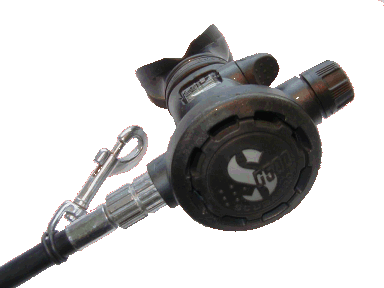 It
is generally advised that you have your regs serviced annually. Maybe you should
get it done more often than that if you dive a lot. You need to take your regs
to an approved service centre. It is not advisable to service them yourself
and it is unlikely that you'll be able to get the service kits anyway. It
is generally advised that you have your regs serviced annually. Maybe you should
get it done more often than that if you dive a lot. You need to take your regs
to an approved service centre. It is not advisable to service them yourself
and it is unlikely that you'll be able to get the service kits anyway.
If you dive using Nitrox, some say you should have your regulators cleaned
and in Oxygen service although the general opinion is that, if your mixes are
less than 40% this is probably not necessary. Again, seek the advice of your
local service technician.
Cylinder Tests
Additionally, you need to get your tanks inspected regularly. If you don't,
dive shops will refuse to fill them.
For full details of the new tests required, click here.
In brief, your air cylinders must be tested every 30 months, alternating between
a visual test and a hydraulic test. The cylinders must be clearly marked with
the last test date and carry an approved sticker showing the contents. Nitrox
(referred to as "enriched oxygen" in the link provided) cylinders
need to be tested every 12 months.
Old Alloy Tanks
This probably won't apply to many club members, but there have been problems
with some old aluminium tanks. Specifically, there was a bad Alloy going around
in the '80s known as 6351-T6 which has been known to explode under pressure.
Such cylinders need a Visual Plus Eddy Current test - your local dive shop will
be able to advise. If you're not sure whether you have such a cylinder, check
the original manufacture date stamped on the cylinder neck. If it's pre-1990,
have it checked just to make sure. Note: this only applies to Alloy tanks (BS5045/3)
and not to those stamped BS5045/3/C which are of a newer grade of alloy.
More
info.
Other Kit
Don't forget that there are other valves and intricate parts on your kit which
will need servicing. These include;
- BCD inflator and dump valves
- Dry suit inflator and dump valve
- Self-inflating DSMBs
There's a lot you can do with your kit to ensure it functions safely and efficiently.
For example, knives and scissors should be washed in fresh water, cleaned of
rust and lubricated. Your Webmaster uses a spray on silicon lubricant which
seems to keep water off the metal quite well. A five year old dive knife is
not showing signs of rusting on the blade yet.
DSMB reels can become tangled or badly wound on to the reels. You can wash
these items and then spool out all the line into a pile on the floor. With the
help of another person you can then wind all the line back so that it lies well
on the reel. Don't forget to check the line for nicks or fraying!
Torches benefit from regular cleaning and battery replacement. Don't wait for
the batteries to let you down on a dive. You might consider a note in the battery
compartment with your name and phone number on it - if you lose it, some kind
soul might just return it.
Check the battery and strap on your computer - if you lose the use of your
computer on a dive you will have to resort to some kind of bailout procedure...and
that's the dive over.
You'll think of other things too - zips need lubricating, fin-straps need checking
etc, etc. It's never ending but don't forget we're dealing with life support
equipment here.
Plan Wisely Dive Safely!
|